
Auto Glass SEO Guide for Windshield Replacement Leads
If you own an auto glass shop, your best salesperson isn’t on your payroll. It’s Google.
If someone within five miles of your shop just cracked their windshield. They’re in a parking lot, frustrated, phone in hand, typing “windshield replacement near me.” This search will take them directly to whatever shop Google shows first. If that is your business , your phone rings. If it’s not, your competitor’s phone rings and you never even knew the job was there.
This is the exact reality of the auto glass business in 2026. Demand is constant. Customers are urgent. And the shop that shows up at the top of Google captures the overwhelming majority of that demand, day in and day out, without paying for a single ad.
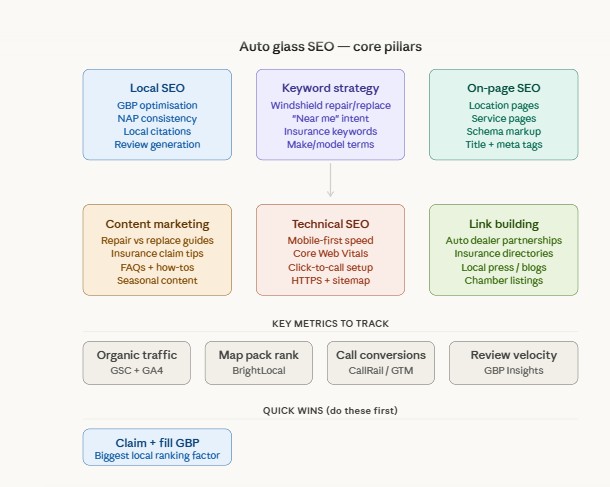
This guide is written specifically for auto glass shop owners , with specific actions you can take yourself or hand off to someone on your team. Whether you run one shop or fifteen, the principles are the same. The difference is in how consistently you apply them.By the time you finish reading, you’ll understand exactly why some shops own their local Google rankings and others don’t and you’ll have a clear, step-by-step plan to get there.
Why Google Search Is the #1 Source of Calls for Auto Glass Shops
Let’s start with why this matters so much more for auto glass than it does for most other businesses.
When someone needs a new couch, they browse for days. When they need a new gym, they compare options for weeks. But when they need a windshield replaced? They need it done today. That kind of immediate, urgent need . What the industry calls “need it now” intent means your customers are not price shopping or reading reviews for hours. They search, they find the top result and they call. The decision happens in under two minutes.
Here’s what that looks like in real numbers. In a typical mid-sized metro area, around 2,500 people search for windshield replacement or auto glass replacement every single month. If your shop appears in the top three results on Google Maps, that small box of three listings that appears above everything else you can realistically receive 400 to 450 calls in a month from that one city alone. At an average ticket of $300 to $325, that’s roughly $87,000 to $90,000 in potential monthly revenue from a single market.
Scale that across five cities where you rank well and you’re looking at $400,000 or more in monthly gross revenue opportunity all from people who were already searching for exactly what you offer.
The auto glass industry is projected to surpass $100 billion in market size in the coming years. The customers are out there, searching every single day. The only question is whether they find your shop or your competitor’s.
Action Item: Pull up your call log from last month. Estimate how many of those calls came from Google searches. That number is your starting point and it tells you exactly how much room you have to grow.
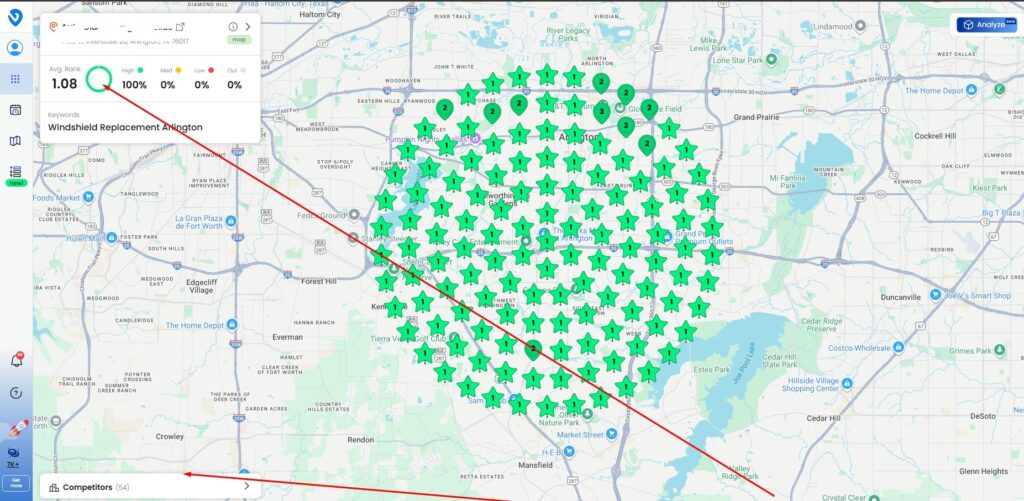
How Google Decides Which Auto Glass Shops to Show (And How to Win)
Google’s local ranking system isn’t random. When someone searches “auto glass near me” or “windshield replacement [city name],” Google runs through a very specific checklist to decide which three shops to show in that top map section.Understanding how this checklist works is the entire foundation of local SEO for auto glass businesses.Google evaluates every local business on three signals:
Signal 1 Distance: How far is your shop from the person searching?
This is the one factor you cannot directly control. Google will always give some preference to shops that are physically closer to the person searching. If someone is searching from across town, businesses near them have a natural geographic advantage.
However, distance is only one of three signals and it can be overcome with stronger relevance and prominence. More importantly, you can expand the geographic reach of your shop by building location-specific pages for the surrounding cities and neighborhoods you serve. We’ll cover this in detail later.
Signal 2 Relevance: Does Google clearly understand what your shop does?
This is where most auto glass shops quietly lose ground to competitors without ever realizing it. Relevance means how well your Google Business Profile and website match what the searcher is looking for.
If your Google Business Profile just says “auto glass” with no specific services listed, or your website has a vague description that doesn’t mention specific services like rock chip repair, ADAS calibration, or mobile windshield service, Google doesn’t fully understand what you offer and won’t show you for those specific searches.Small, targeted improvements to your profile and website can move a shop from position 8 to position 2. This is the highest-leverage area for most shop owners because it’s underutilized by the vast majority of competitors.
Signal 3 Prominence: How trusted and well-known is your business?
Prominence is Google’s measure of your credibility and reputation not just on Google itself but across the entire internet. It’s built from reviews, from how many other websites mention or link to your business, and from how people behave when they find your listing (do they call? Do they click to your website? Or do they immediately go back to search results?).
A shop with 175 reviews receiving 10 fresh new ones every month looks dramatically more prominent to Google than a competitor sitting at 45 reviews that haven’t grown in two years. Google interprets consistent, recent reviews as a strong signal that customers are actively choosing your business.
Win all three signals, be close enough, be clearly relevant, and be demonstrably trusted and you will own your local market.
Google Business Profile for Auto Glass Shops: The Free Tool Most Owners Set Up Wrong
I have been doing auto glass seo and website optimization service for more than 9 years. From my hands on experience , your Google Business Profile is the single most important piece of your online presence. It’s the listing that appears on Google Maps, shows up in that top three box when people search locally, and displays your hours, phone number, photos, and reviews at a glance. And it costs nothing to set up or maintain.
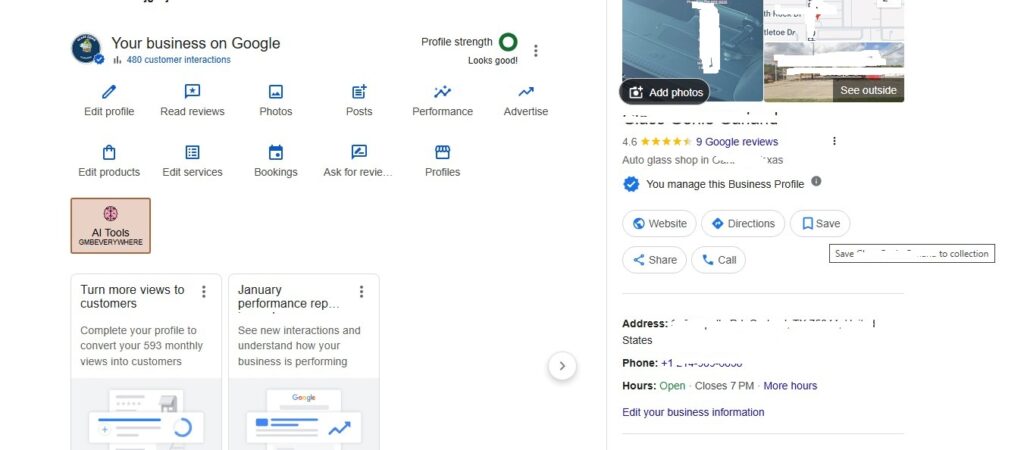
The problem is that most shop owners created their profile years ago, added the basics, and never touched it again. Meanwhile, competitors who actively manage their profiles are quietly outranking them for every auto glass search in the area.
Here’s exactly what a properly optimized Google Business Profile looks like for an auto glass shop in 2026:
Choose the most specific primary category available. Select “Auto Glass Shop” as your primary category, not the broader “Auto Repair Shop.” The more specific your category, the more strongly Google connects your business to auto glass searches specifically. You can add secondary categories like “Auto Glass Repair Service” and Glass Repair as additional categories. That’s what I suggests to every Auto Glass business Owner.
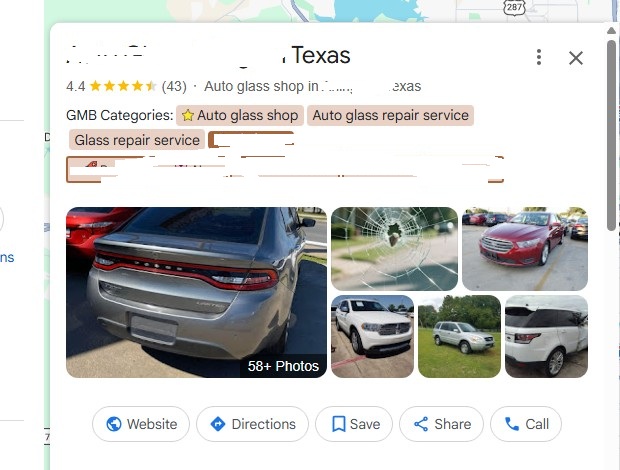
List every individual service you offer with detail. Most shops just write “auto glass” and stop there. Instead, list each service separately: windshield replacement, rock chip repair, side window replacement, rear window replacement, back glass replacement, mobile auto glass service, ADAS recalibration after windshield replacement, and insurance claim assistance. Each listed service makes you more relevant to a broader range of searches. Someone searching specifically for “rock chip repair near me” is more likely to find you if that specific service is in your profile.
Keep your hours current at all times including holidays. Outdated hours are one of the most common and easily preventable reasons auto glass shops lose calls. When someone sees you’re listed as open, calls you, and gets no answer you’ve lost that job and potentially earned a bad review. Update your hours proactively before every holiday and any time your schedule changes.
Add photos consistently, not just once. Google’s algorithm favors profiles that show recent activity. Uploading new photos regularly of your shop exterior, technicians at work, vehicles before and after, your equipment signals to Google that your business is active and legitimate. Profiles with recent photos consistently outperform those with only old or stock images. Aim to add at least two to three new photos every month.
Post updates to your profile regularly. Many shop owners don’t know that Google Business Profiles have a “Posts” feature, similar to a social media feed that appears directly in your listing. A brief weekly or bi-weekly post about a promotion, a tip about windshield care, or a mention of a service you offer keeps your profile fresh and active, another positive signal to Google.
Use the Q&A section proactively. Your profile has a public Q&A section where anyone can ask questions. Populate it yourself with the most common questions customers ask about insurance coverage, how long replacement takes, whether you offer mobile service or not and answer them directly. This content boosts your relevance for those specific questions.
One critical thing most owners don’t realize: Your Google Maps ranking and your regular Google Search ranking are completely separate systems. You can rank at the top of Maps and barely appear in regular search results, or vice versa. The goal is to win both, because they pull from different searchers at different stages of the decision.
Action Item: Log into your Google Business Profile right now and audit it against this list. Check that your primary category is specific, every service is listed individually, your hours are current for the next 30 days, and you have at least 15 photos uploaded, including at least one from the past 30 days.
How to Get More Google Reviews for Your Auto Glass Shop (And Why They Matter More Than You Think)
If there is one single thing that separates auto glass shops that dominate Google from those that struggle, it’s reviews specifically, the combination of how many you have and how recently you’ve been getting them.
Most shop owners understand that reviews matter. What surprises them is how much the freshness of reviews matters. A shop with 80 reviews that has been consistently receiving 8 to 10 new ones every month will frequently outrank a shop with 200 total reviews that hasn’t gotten a new one in six months. Google interprets a steady stream of recent reviews as evidence that customers are actively choosing your business right now which is exactly the kind of current, living business Google wants to recommend.
The math on this is straightforward. If your goal is to stay in the top three on Google Maps, you need to be getting new reviews at a faster or equivalent rate to your competitors. If your closest competitor is sitting at 150 reviews and getting 5 new ones a month, and you have 90 reviews and are getting 12 new ones a month, you will close that gap within weeks and surpass them within months.
The single most effective review system: ask immediately, make it easy.
Most satisfied customers genuinely don’t mind leaving a review. The only reason they don’t is that they forget, or it feels like too many steps. The solution to both problems is a direct text message sent automatically one hour after each completed job, with a single link that takes them directly to your Google review page not to a login page, not to a search page, directly to the review box.
Shops that implement this system typically triple their monthly review volume within the first 60 days. Some use a simple tool like Google’s own “Get more reviews” short link (available in your Business Profile dashboard) combined with a basic text automation. Others use their existing CRM or job management software to trigger the message automatically.
How to handle negative reviews because you will get them.
Every shop gets a negative review occasionally. What matters enormously for both Google and for potential customers reading your profile is how you respond. A calm, professional response that acknowledges the customer’s concern and offers to make it right signals to everyone reading that your shop is run by someone who cares. Never argue. Never ignore. Respond within 24 hours. Google notices active, engaged profile management.
Review diversity matters too. While Google reviews are the most important, having reviews on Yelp, the Better Business Bureau, and Facebook also builds your overall prominence. A customer who searches your shop name and finds consistent positive reviews across multiple platforms is far more likely to call.
Action Item: Set up an automated text message to go out one hour after every completed job. Include a direct link to your Google review page. Set a monthly goal of at least 8 to 10 new reviews per location. Check your profile weekly and respond to every review positive and negative within 24 hours.
Get More Auto Glass Call -Setup 30 Minutes Meeting
Auto Glass Website SEO: What Your Site Needs to Actually Rank on Google
Your Google Business Profile gets you into the Maps results. Your website gets you into the regular search results with the blue links that appear below the map. Both matter, and they work together to give your shop maximum visibility across the entire page.
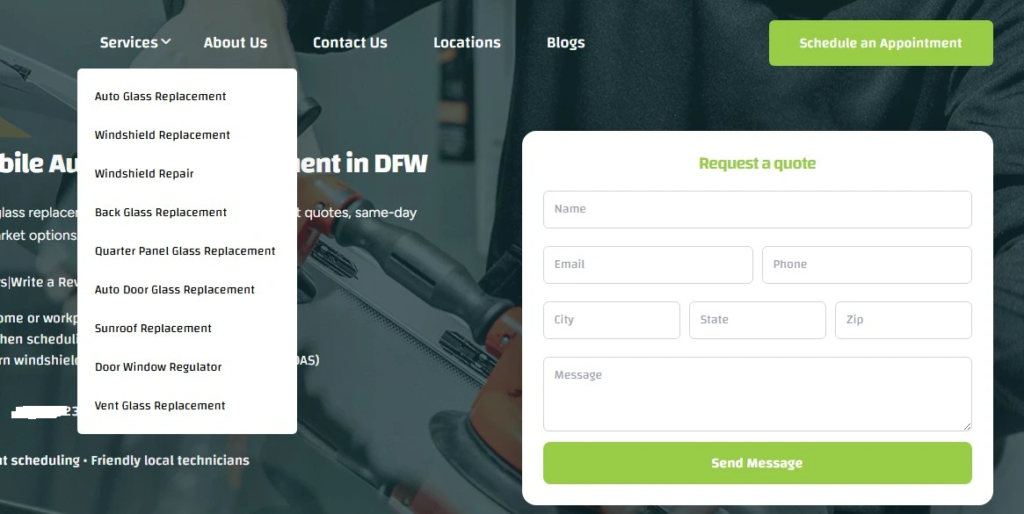
The mistake most auto glass shop websites make is being too generic. A home page that says “We fix all types of auto glass call us today” tells Google almost nothing. It doesn’t match specific search queries, it doesn’t signal expertise, and it doesn’t give Google any reason to rank it above competitors who have more specific, better-organized content.Your home page is the most important page.
Here’s what your website actually needs to rank:
A dedicated page for every service you offer.
Don’t bundle everything onto one page. Each of the following deserves its own dedicated page with a proper title, a full explanation of the service, answers to common questions about it, and a clear call-to-action button:
Windshield replacement +city
Rock chip and crack repair+city
Side window replacement +city
Rear window replacement +city
Mobile auto glass service +city
ADAS calibration and recalibration +city
Insurance claim assistance +city
Fleet and commercial vehicle glass+city
Each page should be written as if you’re explaining that specific service to a first-time customer who knows nothing about it. That depth of content 600 to 1,000 words per page is what signals expertise to Google and earns rankings for the specific searches tied to each service.
Why your ADAS calibration page could be your biggest competitive advantage.
As of 2026, the majority of new vehicles sold in the United States include Advanced Driver Assistance Systems lane departure warnings, automatic emergency braking, forward collision alerts all of which rely on sensors embedded in or near the windshield. When a windshield is replaced on these vehicles, those sensors must be recalibrated before the safety systems work correctly again.
Most auto glass shop websites say nothing about this. Yet the searches for “ADAS calibration after windshield replacement” and “windshield replacement ADAS recalibration” are growing rapidly. A single well-written page that explains what ADAS is, why recalibration is necessary, which vehicle makes and models require it, and that your shop handles it correctly that page alone can pull in a category of high-value, high-ticket customers your competitors are completely ignoring.
Your homepage should target your primary city and key services.
Your main homepage is where you make your broadest statement to Google. It should mention your city and metro area naturally throughout the content, list your primary services clearly, and signal the geographic area you serve. Think of it as your general introduction “We are [City]’s auto glass specialists while the individual service pages handle the specifics.
On-page SEO basics that most shop websites miss:
Every page on your website should have a specific title tag that includes the service and location (example: “Windshield Replacement in Dallas, TX | [Your Shop Name]”). Every page should have a meta description, the short summary that appears under your link in search results that clearly states what the page is about and includes a reason to click. Images should have descriptive alt text (example: “technician installing windshield on 2023 Ford F-150”). Internal links should connect your service pages to each other and back to your main location pages.
None of this is technically difficult. Most website builders and CMS platforms have simple fields for all of this. The shops that fill them in carefully rank above those that leave them blank.
Action Item: Audit your website. Does every core service have its own dedicated page? Does your ADAS calibration page exist? Do your page titles include the service name and city? Start with the two highest-revenue services you offer and make sure those pages are complete before moving to the others.
Website Speed and Mobile Experience: Why Slow Pages Cost Auto Glass Shops Real Calls
Here’s something that surprises most shop owners when they first hear it: your website’s loading speed is a direct ranking factor. Google measures how fast your pages load and uses that as part of its decision about where to rank you. Slow websites rank lower. But the revenue impact goes beyond just rankings.
Research consistently shows that when a website takes more than three seconds to fully load, the percentage of visitors who leave without taking any action increases by 32%. For an auto glass customer standing next to a cracked windshield, needing help now, a slow website isn’t a minor inconvenience, it’s a reason to hit the back button and call the next shop on the list.
Industry data shows that over 64% of auto glass searches happen on mobile phones. That means the experience of using your website on a smartphone not on a desktop computer is what the majority of your potential customers actually encounter. If your site is hard to use on a phone, you are losing more calls than you realize.
What your website needs to pass the mobile test:
Your site should load fully in under 2.5 seconds on a mobile connection. The phone number should be displayed prominently at the very top of the page large enough to read without zooming, and formatted as a tappable link so calling is a single tap. A “Call Now” button should remain visible as the user scrolls down the page. The layout should be clean and readable on a small screen without requiring sideways scrolling or pinching to zoom.
Test this right now: pull up your website on your own phone. Pretend you have a cracked windshield and are in a hurry. Would you call your shop based on that experience or would you go back and call someone else?
How to check your site speed for free:
Google offers a free tool called PageSpeed Insights (search for it by name). Enter your website address and it will score your site on both mobile and desktop performance and show you specifically what’s slowing it down. A score above 70 on mobile is a solid starting point. Below 50 means you’re likely losing both rankings and calls.
Action Item: Test your website on your own phone right now. Then run it through Google’s PageSpeed Insights. If your mobile score is below 70, share the results report with your web developer the tool tells them exactly what needs to be fixed.
Local SEO City Pages: How Auto Glass Shops Rank in Every Neighborhood They Serve
If you serve more than one city, or if your shop is located in a major metro area where customers come from dozens of surrounding suburbs and neighborhoods, city pages are the most direct way to expand your Google ranking footprint without opening new locations.
Here’s the core idea: Google gives ranking preference to businesses that have specific, relevant content about the geographic area being searched. If someone in Plano, Texas searches for “windshield replacement Plano,” a shop with a dedicated Plano page will consistently outperform an equally qualified shop that only has a generic Dallas page.
How to structure your location pages for maximum ranking power:
Your main homepage targets your primary city and general service area. Every suburb, neighboring city, and major neighborhood you serve gets its own individual page. A “Locations” or “Service Areas” page on your site links to all of them, and your homepage also links to your top markets.
Each city page should contain 800 to 1,000 words of content that is genuinely specific to that location. This is where most shops go wrong; they create city pages by copying their main page and swapping the city name. Google identifies this as thin, duplicate content and simply won’t rank it. The content must be actually different.
What makes a city page genuinely unique and rankable:
Include a description of the specific neighborhoods within that city you serve. Mention nearby landmarks that customers would recognize as reference points for your location. Note any local specifics that are relevant if that city has a particularly common vehicle type, a major employer whose fleet you service, or a notable stretch of highway known for rock chips, mention it. Include directions from a well-known local point. Feature testimonials or mentions from customers in that specific area. List the insurance providers most commonly used in that market.
This level of local specificity signals to Google that your page is genuinely relevant to that area, not a copy paste placeholder.
A realistic example of what this looks like at scale:
A shop based in Fort Worth, Texas might serve Fort Worth itself plus Arlington, Mansfield, Burleson, Crowley, Benbrook, White Settlement, and Haltom City. That’s eight city pages, each with unique content, each targeting a different set of local searches. Instead of competing for the same “Fort Worth windshield replacement” search eight different ways, each page opens up an entirely new pool of local searches potentially adding hundreds of additional calls per month across the full service area.
Action Item: List every city, suburb, and major neighborhood you currently serve. Then check your website does each one have its own dedicated page with unique content? Start with the three highest-revenue markets outside your primary city and build those pages first.
Keyword Research for Auto Glass Shops: Find the Exact Searches Your Customers Are Using
One of the most common mistakes auto glass shop owners make when they start thinking about SEO is targeting the words they think their customers use rather than the words their customers actually type into Google.
These two things are often different. You might think everyone searches for “auto glass repair” when a significant portion of your potential customers are actually searching “windshield crack fix” or “car window replacement” or “broken side window repair.” Spending months optimizing for terms nobody searches for is one of the fastest ways to waste your SEO investment.
High-value search terms every auto glass website should target:
Emergency and same-day searches: “same day windshield replacement,” “emergency windshield repair near me,” “windshield replacement open now,” “windshield replacement today”
Mobile service searches: “mobile windshield replacement,” “windshield replacement come to me,” “mobile auto glass service near me”
Insurance-related searches: “insurance windshield replacement,” “free windshield replacement insurance,” “does insurance cover windshield replacement,” “file windshield claim”
Vehicle specific searches: “truck windshield replacement,” “SUV windshield replacement,” “commercial vehicle glass repair,” “fleet glass services”tesla windshield replacement , Ford windshield replacement etc
Technology-related searches: “ADAS windshield calibration,” “windshield replacement sensor recalibration,” “OEM windshield replacement”
Specific damage searches: “windshield crack repair,” “rock chip repair windshield,” “side window replacement,” “rear window replacement”
How to find the actual search terms your local customers use:
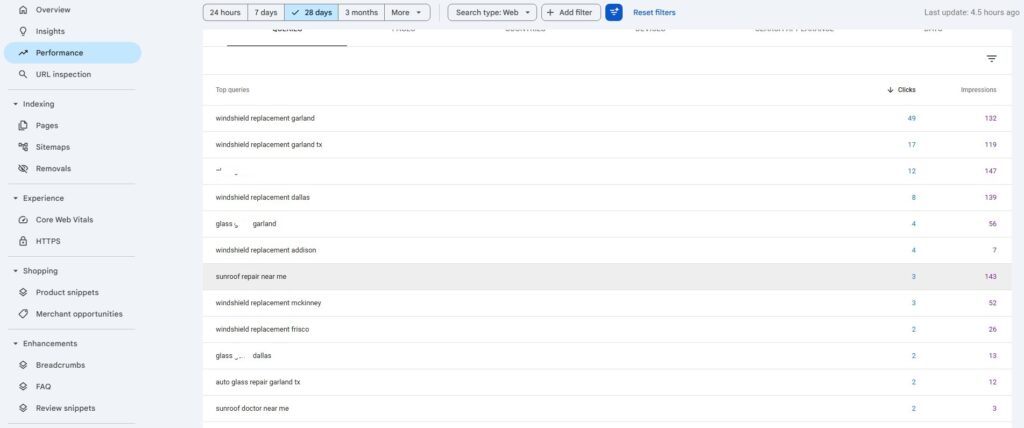
Google Search Console (free, linked to your website) shows you the exact search queries that brought visitors to your site. Review this monthly you’ll often discover searches you’re appearing for that you didn’t intentionally target, and searches you’re ranking low for that represent easy improvement opportunities.
Google’s own autocomplete is also a valuable free research tool. Start typing “windshield replacement” into a Google search and observe every suggestion that appears. Each suggestion represents an actual search people perform frequently. These are your content targets.
Action Item: Open Google Search Console and look at your top 20 search queries from the past 90 days. Identify which ones are driving the most clicks and which ones you’re ranking between position 5 and 15 for those are your highest-priority improvement opportunities.
Get More Auto Glass Call -Setup 30 Minutes Meeting
Auto Glass FAQ Pages: How to Show Up in Voice Search, Google Snippets, and AI Answers
Google’s search results page has changed dramatically. It’s no longer just a list of links. At the top of many searches, Google now displays a direct answer pulled from whichever website it determines best addresses the question. This is called a Featured Snippet, and it appears above all the regular results. Getting your content into that position is the equivalent of ranking number zero.
Voice search and AI-powered search tools work the same way. When someone asks their phone “will insurance cover my cracked windshield?” The AI doesn’t show a list of links, it reads an answer directly from a website it trusts. That website could be yours.
The way to appear in Featured Snippets, voice search answers, and AI search results is the same: have clear, well-written, direct answers to the exact questions your customers ask, organized in a FAQ format on your website.
Every auto glass website should have clear written answers to these questions:
Does car insurance cover windshield replacement? In most cases, yes if you have comprehensive coverage on your policy, your insurance will cover windshield replacement, often with no deductible depending on your state. Your auto glass shop can typically handle the insurance paperwork directly so you don’t have to.
How long does windshield replacement take? A standard windshield replacement takes approximately 60 to 90 minutes from start to finish. However, you should wait at least one hour after installation before driving, and the adhesive reaches full strength within 24 hours, so avoiding car washes or high-pressure situations during that period is recommended.
Can I drive immediately after windshield replacement? Most shops recommend waiting at least one hour before driving after a windshield replacement. The urethane adhesive used to seal the windshield needs time to cure. Your technician will give you the specific safe drive-away time based on the adhesive and conditions.
What is ADAS calibration and does my car need it? ADAS stands for Advanced Driver Assistance Systems, the suite of safety features in newer vehicles like automatic emergency braking, lane keeping assist, and forward collision warnings. Many of these systems use cameras or sensors mounted near the windshield. When a windshield is replaced, those sensors must be recalibrated using specialized equipment to ensure the safety systems work correctly. Most vehicles manufactured after 2018 require ADAS recalibration after windshield replacement.
Do you use OEM glass or aftermarket glass? OEM (Original Equipment Manufacturer) glass is made to the exact specifications of your vehicle’s original windshield. Aftermarket glass is manufactured by a third party to similar but not identical specifications. Quality shops offer both options and explain the differences OEM glass is typically recommended for newer vehicles with ADAS systems to ensure proper sensor function.
Do you offer same-day windshield replacement? Many auto glass shops offer same-day service for windshield replacement, depending on glass availability and appointment scheduling. Mobile services where a technician comes to your home, office, or wherever your vehicle is located are also widely available and often schedulable within the same day.
Can you replace glass on any vehicle, including trucks, SUVs, and commercial vehicles? Reputable auto glass shops carry or can source glass for virtually any passenger vehicle, truck, SUV, van, or commercial fleet vehicle. Commercial fleet services, where a shop services multiple company vehicles, are a growing part of the auto glass market.
Write these answers on your FAQ page, on your service pages, and on your homepage. Write them in the same plain language you’d use talking to a customer at your counter. The shops whose content Google trusts enough to display as a direct answer are the ones whose expertise shows in how they write clearly, specifically, and without jargon.
Action Item: Add a FAQ section to your homepage, your main windshield replacement page, and your ADAS calibration page. Write each answer in 2 to 5 sentences in plain language. This content takes about two hours to create and can generate Featured Snippet appearances within weeks.
How to Build Local Authority: Partnerships and Citations That Boost Your Auto Glass Rankings
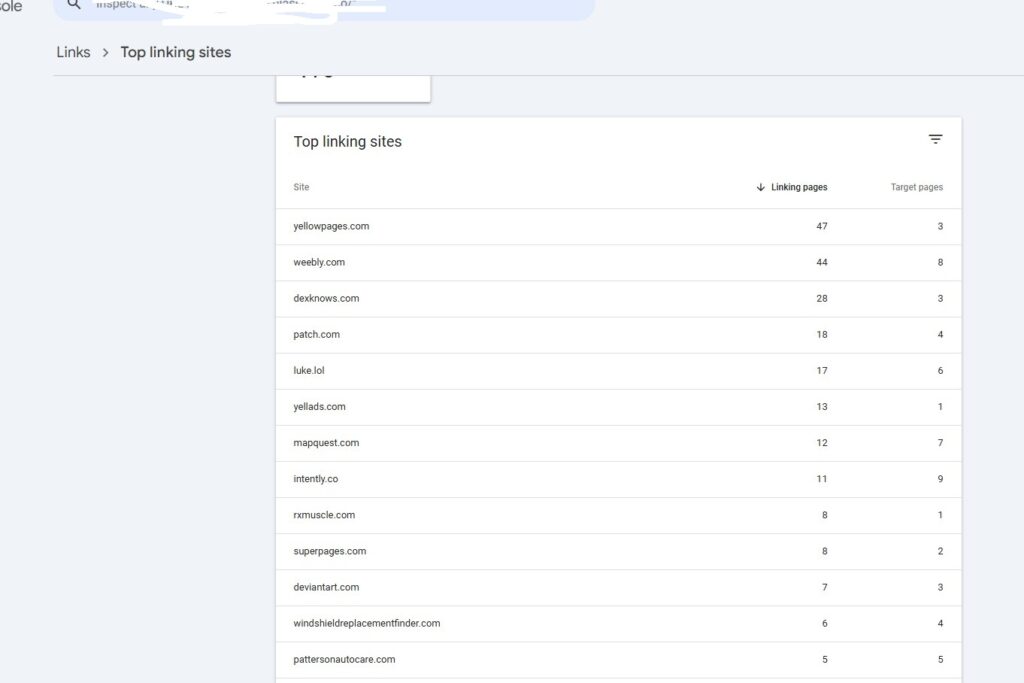
Reviews and website content get you far. But Google’s prominence signal goes beyond what’s on your own profile and website; it measures how often and how credibly your business is mentioned across the broader internet. This is called building local authority, and it’s what separates shops that rank well in competitive markets from those that stall out despite doing everything else right.
Think of it as online word-of-mouth. Every time a reputable website, a local dealership, an insurance agent’s website, a Chamber of Commerce directory, a local news outlet , local blogger ,reddit or local facebook group mentions your shop by name or links to your website, it’s a vote of confidence in Google’s eyes. The more of these votes you accumulate from credible local sources, the more prominent Google considers your business.
NAP Consistency: The Foundation That Everything Else Depends On
Before you build any new authority, make sure your business name, address, and phone number (called NAP in marketing circles) are exactly identical everywhere your business appears online. Same abbreviations, same suite numbers, same phone number format. If your listing on Yelp says “Suite 200” but your Google profile says “Ste 200” and your website says nothing about a suite number, Google’s algorithm detects the inconsistency and reduces its confidence in your business’s legitimacy. Audit your NAP across Google, Yelp, Facebook, the Better Business Bureau, Yellowpages, Angie’s List, Foursquare, and any local directories. Correct every inconsistency.
Business Directory Listings and Citations
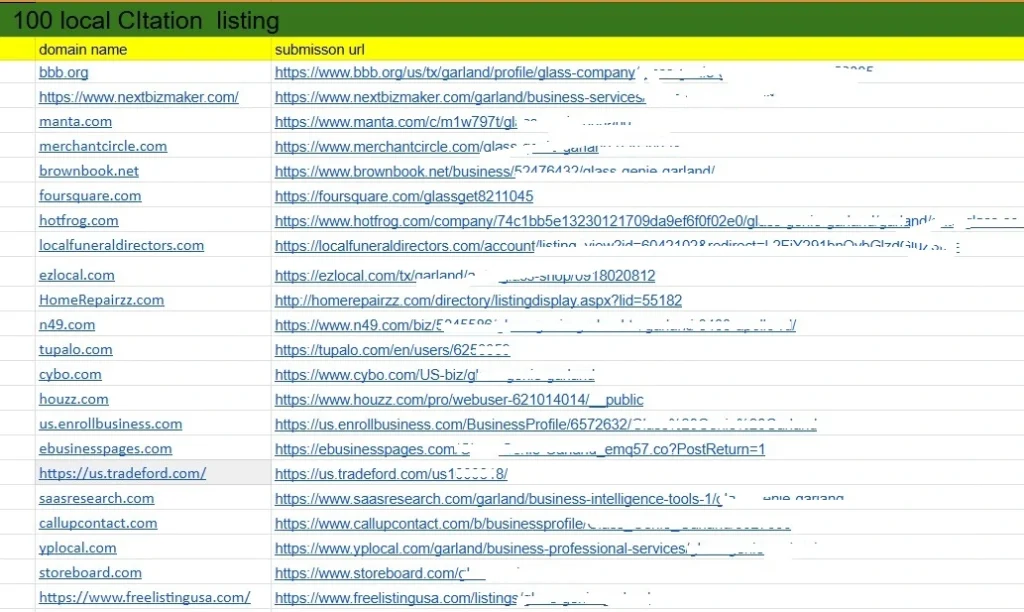
Your shop should be consistently listed across at least 40 to 60 local and industry-relevant business directories. Beyond the major ones (Google, Yelp, Facebook, BBB), look for automotive-specific directories, local city directories, and home services platforms. Each consistent listing is a citation or a mention of your business that reinforces to Google that your shop is a real, established local business.
Partner with Local Car Dealerships
Car dealerships are a natural referral partner for auto glass shops. They have customers who need glass work continuously after test drives, during purchases, for used inventory, and for service department referrals. A working relationship with even two or three local dealerships can generate consistent monthly work, and a mention or link on their website carries significant authority. Reach out directly to the service managers or general managers of dealerships in your area. Offer a preferred pricing arrangement or quick turnaround guarantee in exchange for referrals.
Build Relationships With Local Insurance Agents
Independent insurance agents make referrals for auto glass claims regularly. They’re often looking for a reliable local shop they can recommend confidently to their clients. A few phone calls or brief visits to independent agents in your area introducing yourself, leaving cards, explaining your process for handling insurance claims can open referral channels that generate calls for years. Some agents will also mention you on their website or social media, adding another citation to your authority profile.
Get Listed With Your Local Chamber of Commerce
Chamber of Commerce memberships are affordable for most businesses and come with a trusted directory listing. Google recognizes Chamber citations as credibility signals. Many Chambers also feature member businesses in newsletters, social posts, and events additional mentions that build your prominence.
Sponsor Local Events, Schools, and Sports Teams
Local news websites, school websites, and community organization pages frequently publish lists of sponsors and those mentions include your business name and often a link to your website. A youth sports team sponsorship or a local community event sponsorship costs very little and generates the kind of genuine, local, trusted mentions that Google values highly. It also puts your name in front of families in your service area.
Action Item: Start with NAP consistency, audit every place your business is listed online and correct any discrepancies this week. Then identify three dealerships and three insurance agents in your area to contact this month. These relationships take time to build but compound in value over years.
Google Search Console and Analytics for Auto Glass Shops: How to Track Your SEO Results
There’s no point putting time and money into your Google presence if you can’t measure what’s working. The good news is that Google provides two completely free tools that show you exactly how your shop is performing in search and most shop owners have never used either one.
Google Search Console is your direct window into how Google sees your website. It shows you every search term your website appeared for in the past 90 days, how many times it appeared (impressions), how many times someone actually clicked on it (clicks), and your average position for each term. This data is invaluable.
Every month, open Search Console and look for two specific patterns. First, find the keywords where you’re getting many impressions but few clicks. These are searches where Google is showing your site but people aren’t clicking through, which usually means your title or meta description needs to be more compelling. Second, find keywords where you’re ranking between position 5 and 15. You’re close to the top three but not there yet, which means targeted content improvements on those specific pages can move you into the high-traffic zone.
Search Console also alerts you to technical problems on your website broken pages, indexing issues, or mobile usability errors that could be silently hurting your rankings.
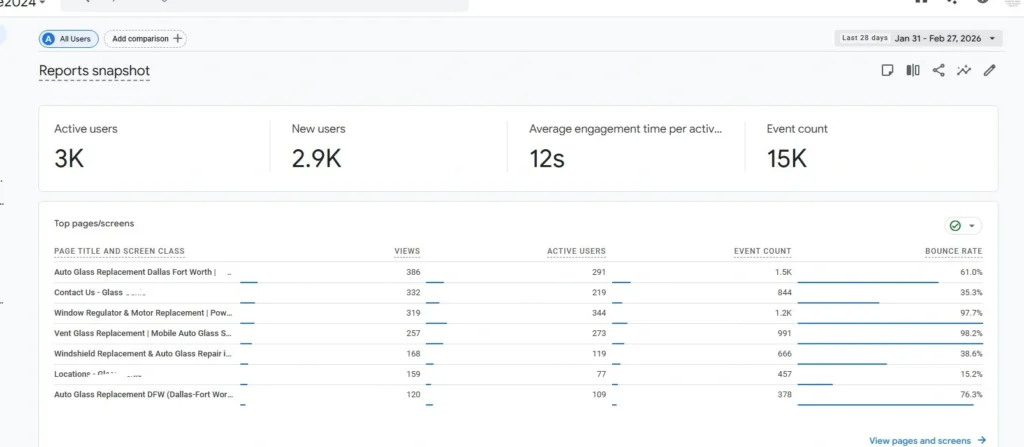
Google Analytics shows you what visitors do after they arrive on your website. How many people visited? How long did they stay? Which pages did they look at? Where did they come from Google search, Google Maps, a referral from another site, or direct traffic? Did they click your phone number?
The specific metric to watch as an auto glass shop owner is phone number clicks on mobile that’s the action that leads directly to revenue. If you’re getting strong traffic but low phone clicks, your page layout or call-to-action needs attention. If phone clicks are high but call volume doesn’t match, your tracking number setup may need review.
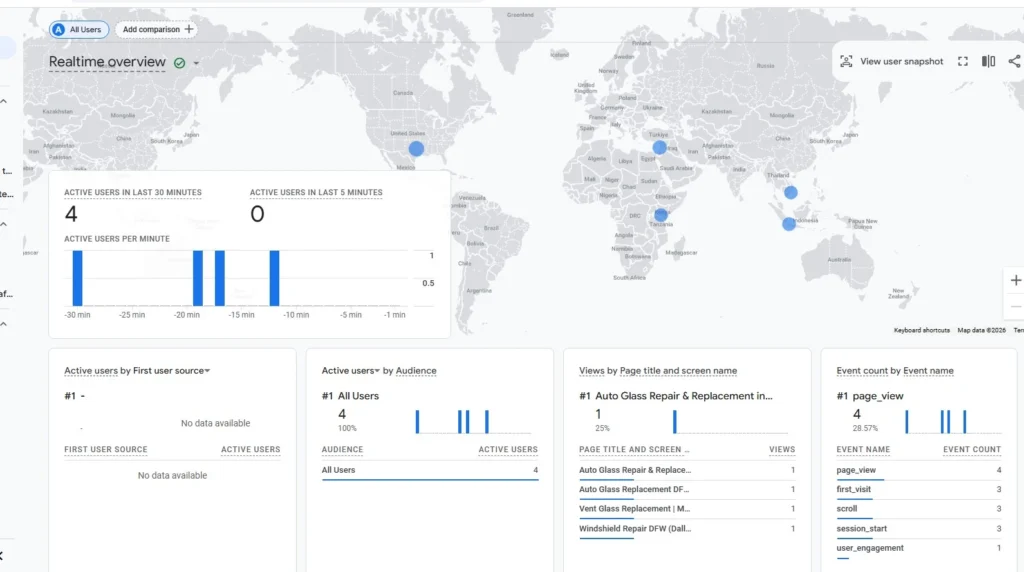
Setting both up takes about 15 minutes each and both are free. Search for “Google Search Console setup” and “Google Analytics 4 setup” to find Google’s own step-by-step guides. If you use a website management service, they can usually set these up in minutes.
If you’re working with a marketing company or SEO agency on your auto glass business, ask them to share monthly reports from both tools. If they’re not using these tools to manage your campaign, that’s a serious red flag.
Action Item: Set up Google Search Console and Google Analytics this week. Once they’ve collected 30 days of data, look at your top 20 search terms in Search Console and identify the two keywords with the most impressions where you’re ranking between positions 5 and 15. Those are your first optimization targets.
What Better Google Rankings Actually Mean for Your Auto Glass Revenue
Let’s make this concrete. A shop that moves from the bottom of page one to the top three positions in Google Maps for a single mid-sized city can expect call volume to increase by 150 to 300 additional calls per month from that market alone. At a close rate of 55 to 60 percent and an average ticket of $325, that’s $26,000 to $58,000 in additional monthly revenue from one city.
For a multi-location operator ranking in the top three in five cities, the math compounds to $130,000 to $290,000 in additional monthly gross revenue opportunity all from capturing demand that already exists and is being lost to competitors every single day.
Beyond the direct revenue impact, there’s a compounding effect that most shop owners don’t fully appreciate. Every new customer generated through organic search without paying for an ad who then leaves a review, creates a virtuous cycle. More reviews improve your ranking. Better ranking generates more customers. More customers generate more reviews. The longer you run this cycle consistently, the more your cost to acquire each new customer decreases, and the harder it becomes for competitors to displace you.
Shops that build their Google presence systematically with active Business Profiles, consistent reviews, dedicated service pages, fast mobile websites, properly built city pages are building a competitive moat that pays dividends for years. Those that ignore it are funding their competitors’ growth.
Get More Auto Glass Call -Setup 30 Minutes Meeting
Auto Glass SEO Checklist: 4 Steps to Start Ranking Higher on Google This Week
Everything in this guide works. But if you’re feeling like this is a lot to tackle at once, start here. These four actions address the highest-leverage opportunities for most auto glass shops and can produce visible results within 30 to 60 days.
Step 1: Optimize your Google Business Profile. Log in today. Confirm your primary category is “Windshield Repair Service.” Add every service you offer as individual line items. Verify your hours are correct for the next 30 days. Upload at least 5 new photos if you haven’t added any in the past 60 days.
Step 2: Build your review system. Set up an automated text message to go out one hour after every completed job with a direct link to your Google review page. Set a goal of 8 to 10 new reviews per location per month. Respond to every review positive and negative within 24 hours.
Step 3: Fix your mobile website experience. Pull up your site on your own phone right now. Is the phone number visible immediately? Does a tap on it dial automatically? Does the page load in under 3 seconds? Run the site through Google PageSpeed Insights. If you score under 70 on mobile, address the top issues your developer flags immediately.
Step 4: Audit and build your city and service pages. Check that your two highest-revenue services each have their own dedicated page with at least 600 words of specific content. Check that the top three markets you serve outside your primary city each have a unique, non-duplicate location page. If any of these are missing, build them in order of revenue priority.
These four steps, executed consistently, will put you meaningfully ahead of the majority of auto glass competitors in your market, most of whom are not doing all four of these things at once.
Auto glass is one of the highest-urgency, highest-intent local service categories in existence. Every single day, hundreds of people in your market are searching for exactly what you offer. With a Google presence built correctly and maintained consistently, the answer to “which shop should I call?” can almost always be yours.
The auto glass market rewards the shops that show up. Build your presence now, maintain it consistently, and let Google’s daily stream of urgent, ready-to-buy searchers fill your schedule.
You can check our case study on Auto Glass SEO here
How do I boost local SEO for an auto glass repair business?
Getting your auto glass shop noticed locally takes more than just setting up a Google Business Profile (GBP). You need a multi-layered approach that nails the technical side, crafts location-focused content, and builds genuine local credibility.
The Three Key Moves for Local SEO in Auto Glass
Think of your Google Business Profile as mission control for local searches. Make sure you pick “Auto Glass Shop” as your main category—not something broader like “Auto Repair Shop.” Then, add related categories such as “Windshield Repair Service” or “Auto Body Shop.” Don’t forget to upload photos tagged with your location—snapshots of your storefront, the team in action, or a freshly fixed windshield. Google’s image algorithms connect these images to where you’re based, which helps.
Content That Speaks to Each Neighborhood
Instead of one vague service page, build separate pages tailored to each city or zip code you serve. For example, a page titled “Windshield Repair in [City Name]” should run at least 600 words and include details specific to that area. Throw in embedded Google Maps and reviews from customers nearby. This local flavor beats generic pages when it comes to showing up in local search results.
Must-Dos for Your Local SEO Setup
Start by making sure GBP lists ‘Auto Glass Shop’ exactly right. Then create those city-specific pages—each with solid detail. Add LocalBusiness schema markup including coordinates and how far you travel for repairs. Get listed on auto-focused directories like AutoGlass.com, Glass.com, and RepairLink—they matter more than generic directories here. Encourage customers to leave reviews mentioning particular services like “windshield replacement” or “ADAS recalibration.” Adding FAQ schema can help snag featured snippets on search results too. Lastly, tools like BrightLocal or Whitespark will help keep your citations consistent across dozens of listings.
Keep an eye on how you rank using BrightLocal’s rank tracker—especially for phrases people use when ready to buy: “same-day windshield replacement [City]” or “mobile auto glass repair near me.” Ranking isn’t everything; catching those high-intent searches is where the money is.
This isn’t quick work—local SEO takes patience and attention—but nailing these steps puts your shop right where people are looking when they need help fast.
What SEO tools work best for auto glass service companies?
When it comes to SEO for an auto glass business, you need tools that cover four key areas: tracking local visibility, tweaking on-page elements, spying on competitors, and managing citations. Many all-purpose SEO platforms don’t quite capture the local details that really move the needle for service shops like these.
Starting with the essentials—tools you can’t skip:
Google Search Console shows which keywords actually get your pages seen and flags crawl issues on your service pages. Then there’s Google Business Profile Insights; it lets you watch how people interact with your listings through map clicks, calls, and direction requests by location. BrightLocal is great for businesses with multiple spots—it tracks rankings across locations, audits citations, and helps manage reputation. Semrush or Ahrefs come in handy to spot where competitors are winning keyword-wise, analyze backlinks, and uncover content chances. Finally, Screaming Frog runs deep technical checks—finding broken links, missing schema tags, or duplicated content.
Now here’s where things get a bit more tailored: certain tools target auto glass companies specifically. For example, Glass.com’s vendor portal and AutoGlass.com’s directory act as powerful citation sources that standard SEO software might not catch automatically. Adding Whitespark Local Citation Finder helps reveal niche directories your rivals rely on. CallRail is critical because it traces which SEO efforts actually lead to phone calls—a huge deal since most auto glass customers pick up the phone first during emergencies. ReviewTrackers or Podium simplify keeping tabs on reviews across Google, Yelp, and Facebook all at once. And don’t forget Google’s PageSpeed Insights—auto glass customers usually search on their phones when they need help fast; if your site doesn’t load in under two seconds, expect ranking trouble.
For shops juggling just one to five locations? BrightLocal’s Agency plan (ranging from $49 to $79 per month) often delivers the best bang for your buck by combining local rank tracking with review management in one package.
It’s not just about having every tool out there but picking ones that fit how your customers find and choose you—especially when time matters most.
What SEO support do leading auto glass marketing firms provide?
The best auto glass marketing teams like the opticrawl local seo team don’t just stop at basic SEO. They craft strategies that cover every step—from grabbing local attention to turning clicks into customers. Knowing what truly effective service looks like can save shop owners from paying too much for cookie-cutter offerings.
Main SEO services specialized agencies bring to the table
First, they zero in on Local SEO and owning the Map Pack. That means polishing up Google Business Profiles, structuring service-area pages smartly, building citations across more than 50 directories, and tailoring keywords specifically for each neighborhood or city.
Next comes technical SEO checks and fixes. Think schema markup targeting LocalBusiness info, FAQs, and services like windshield repair or replacement. Plus, they fine-tune Core Web Vitals—those speed and usability signals Google cares about—and improve how easily search engines crawl the site.
Content plays a huge role too. These teams build “hub and spoke” models focused on key topics: windshield repair, ADAS recalibration (yes, that’s a thing), rock chip fixes, even mobile auto glass work. This approach aims to make their client’s website the go-to authority in their region.
Conversion Rate Optimization is where the magic turns traffic into booked jobs—adjusting click-to-call buttons, streamlining quote forms, and making appointment setups as painless as possible.
Finally, reputation management isn’t left to chance. Agencies run review-gathering campaigns right after service via SMS or email follow-ups; they respond thoughtfully to feedback and handle negative reviews with care.
Watch out for warning signs when picking an agency: anyone promising exact Google rankings should be met with skepticism—they can’t guarantee that without cutting corners. Also be wary if all they offer is link building without a solid citation or content game plan; no case studies related to auto glass or similar fields; contracts without monthly updates; or bundled services that mix unrelated tasks like social media at inflated costs.
To sum up: real value lies in thoughtful local focus, technical precision, content depth, conversion tweaks, plus reputation upkeep—all working together rather than isolated tactics thrown your way.
What does SEO usually cost for an auto glass business?
SEO budgets for auto glass shops swing widely. It depends on how fierce the competition is, how many locations you have, and what services you want to cover. Knowing the general price ranges can help you figure out what kind of results to expect without breaking the bank.
SEO Price Ranges for Auto Glass Shops
Starting at about $500 up to $1,000 a month, you get basic local SEO—things like optimizing your Google Business Profile, building citations, and simple on-page tweaks. This works fine if you’re a single-shop operation in an area with little competition. Step it up to $1,500–$3,000 monthly and you’re looking at full local SEO: targeting multiple cities, creating service-area pages, fresh content creation, and managing reviews. That suits more established shops in moderately competitive markets.
If your business stretches across several locations or runs like a franchise chain, budgets from $3,500 to $7,000 make sense. You’ll get technical SEO work alongside multi-location management and specialized content—think ADAS features—and efforts to push competitors down the ranks.
Finally, if your brand spans several states or even nationwide with multiple sites involved, spending upwards of $8K per month lands you enterprise-level campaigns: custom dashboards for reporting every detail plus PR-driven link building with a dedicated team behind it all.
How do these costs pay off? Picture this: replacing one windshield brings in roughly $350 per job; after parts and labor costs eat their share (about 70%), that leaves around 30% profit margin. Add just one more job each week thanks to better SEO—that’s close to $18K extra gross profit over a year.
If you spend around $2K monthly on SEO (or $24K annually), getting three or more new jobs weekly means at least double your investment back—even before counting referrals from insurance companies or repeat clients who keep coming back.
Don’t settle for vague reports either. Demand monthly updates showing organic website visits, rankings in map searches (“map pack”), phone calls tracked from online searches, and quote requests submitted through your site forms.
If an agency can’t connect their work directly to real revenue gains? They’re probably not worth your time—or money.
Which digital marketing tactics actually move the needle for auto glass shops?
When it comes to auto glass, people don’t shop around casually. They usually only think about fixing a windshield when something urgent happens—a crack or chip that can’t wait. So, any marketing play has to show up right when someone’s in that moment of need, not months earlier trying to build brand awareness.
The Auto Glass Marketing Approach That Gets Results
First off: Local SEO earns the biggest payoff over time. Getting your shop into the top three spots on Google Maps for searches like “windshield replacement [your city]” pulls in a solid 60 to 80 percent of calls from customers who already want service. It’s like being right there at the intersection of intent and convenience.
Then there’s Google Local Services Ads (LSAs). These pop up above all other ads and organic links and flaunt that Google Guaranteed badge—which gives customers instant confidence. Plus, leads here cost anywhere from $15 to $40, way cheaper than typical Google Ads. This channel is your fast lane for new leads while you wait for SEO efforts to settle in.
Next up are standard Google Search Ads aimed at people typing high-intent phrases such as “auto glass repair same day” or “insurance windshield replacement [city].” Since most sales happen over the phone, running call-only ads is smart—you skip clicks and go straight to conversations.
Don’t underestimate review power either. Shops with 200-plus Google reviews averaging 4.7 stars or higher tend to dominate map rankings and click rates. Setting up an SMS follow-up after each job—sending customers a direct link to leave a review—makes a big difference here.
Finally, content marketing pulls in folks who are researching before they commit. Think articles answering questions like “does insurance cover windshield replacement?” or “how long does it take?” Even technical topics such as “ADAS recalibration after windshield replacement” catch attention from those digging deep—and once you build trust through helpful info, these readers turn into buyers more often than you’d expect.
In short: show up locally where demand exists, get quick leads with LSAs, target serious searchers with call-only ads, gather heaps of great reviews, and publish smart content that speaks directly to curious customers in research mode. Nail these steps and watch business grow steadily—even though most sales come out of sudden needs rather than slow browsing habits.
Which keywords pull in the most traffic for auto glass businesses?
Trying to pin down the best keywords for auto glass isn’t as simple as picking the ones with the highest search numbers. Often, those popular terms don’t bring in buyers ready to act. A smart keyword plan juggles search volume, what people actually want, and how tough it is to rank—pointing you toward traffic that actually matters.
Top Keyword Groups That Matter for Auto Glass SEO
First up: phrases that scream “ready to buy.” Think “windshield replacement [city/state],” “auto glass repair near me,” or “same day windshield repair.” These get anywhere from 500 to over 5,000 searches a month depending on where you are—and about 15% to 30% of those clicks turn into customers.
Then there’s insurance-related keywords. Phrases like “does insurance cover windshield replacement” or “windshield replacement no deductible” might not be the flashiest but they pull serious weight. These queries show high intent and usually have less competition because they tackle a common sticking point—cost objections disappear when insurance is involved.
Don’t overlook people still figuring out their problem: “windshield crack repair vs replacement,” or “can you drive with a cracked windshield.” These folks aren’t ready yet but snagging their attention early means you can reel them in before competitors do.
Vehicle-specific searches are often overlooked but pack a punch if you’re aiming at precision buyers: things like “[vehicle make/model] windshield replacement cost” or specific models such as “Tesla Model 3 windshield replacement.” These long-tail terms have lower competition and hint at someone close to making a decision.
Lastly, keep an eye on ADAS and tech-related keywords — topics like “ADAS recalibration after windshield replacement” or comparisons between OEM and aftermarket windshields. As cars get smarter, these searches are creeping up, though right now they face little competition.
Tools That Help Track These Keywords
Try Semrush’s Keyword Magic Tool if you want to separate terms by user intent and zero in on local modifiers; it’s surprisingly handy. Google Keyword Planner also helps check how many folks actually search your target phrases around your city. For question-heavy ideas perfect for FAQs or blog posts, AnswerThePublic brings up useful queries customers really ask online.
To be honest, mixing these sources gives you a fuller picture than relying on just one—it’s worth the extra legwork if you’re serious about growing organic visits that convert.
Q6 How can I fine-tune my website content to rank well for auto glass keywords?
Getting your auto glass site to stand out in search isn’t just about tossing in a few keywords here and there. You need a clear plan that mixes the main commercial terms with more detailed, question-driven phrases people actually type when they’re curious or cautious. The idea? Make Google see your site as the go-to spot for everything related to auto glass—especially around your town or city.
Breaking down the Keyword Layers
Think of your content like a pyramid with three levels:
First, you’ve got the big hitters—the key service terms like ‘windshield replacement [city],’ ‘auto glass repair [city],’ or ‘windshield chip repair near me.’ These belong on your main service pages and need full-on SEO attention.
Next, dive into more specific services such as ‘back glass replacement,’ ‘door glass repair,’ or ‘ADAS recalibration.’ These get their own detailed pages because they’re important but less searched.
Lastly, there’s the long-tail stuff—the questions folks ask like ‘does insurance cover windshield replacement,’ or ‘can you drive after windshield replacement?’ This info shines best in blog posts or FAQs where you can really explain things.
What To Do On Each Service Page
Make sure you place your top keyword right in the headline (H1), meta title, and within the first 100 words on the page. Sprinkle in related terms too: think ‘windshield,’ ‘vehicle glass,’ ‘chip repair’—variety helps.
Show off where you operate by embedding a Google Map with pins marking your area. Use schema markup tailored for local business and services—that little extra coding detail helps search engines understand who you are and what you do.
Don’t forget mobile users: slap a click-to-call button right at the top so it’s easy to contact you without hunting around.
Add some local flavor—mention nearby landmarks, clarify which neighborhoods or zip codes you serve, maybe note if you offer quick delivery.
Link from relevant blog posts back to these service pages; this helps spread authority across your site.
A common trap? Making multiple location pages that only swap out city names without changing much else. Search engines catch on fast. Each location page should have fresh details—think real customer reviews from that area, maps showing precise coverage zones, even local trust badges—to make every page truly unique and valuable.
Q11 How can I claim and boost my Google Business Profile for auto glass services?
If you want local customers to find your auto glass shop, nothing beats a well-tuned Google Business Profile (GBP). It often outranks websites—even those with stronger domain authority—because GBP directly feeds into the three main things Google looks at for local results: relevance, distance, and prominence.
How to Optimize Your Auto Glass Shop’s GBP
First off, claim your listing. Head over to business.google.com, search your business name, and take ownership. You’ll usually verify by postcard sent through the mail—but sometimes instant phone or video verification pops up too. Avoid creating a second listing at all costs; track down any unverified profiles first.
Next, nail down your categories. Make “Auto Glass Shop” your main category—that’s the biggest ranking factor here. Then add others that fit what you do: “Windshield Repair Service,” “Auto Body Shop,” or “Glass Repair Service.” These help Google understand exactly what you offer.
Don’t skip filling out every profile detail. That means business hours (including holidays), service areas (list every city or zip code you cover), a clear description packed with relevant keywords (keep it natural; about 750 characters is good), plus the services section where you break down each offering like windshield replacement, chip repair, door glass fixes, back glass repairs, even ADAS recalibration if you do that.
Photos matter more than you’d think. Upload at least 25 pictures showing off your shop from different angles outside and inside—snap shots of techs working on cars, finished repairs side-by-side with before shots—and don’t forget your service vehicles if they’re branded. Rename each photo file before uploading so it includes keywords and location info—for example: “windshield-replacement-[city]-[your-business-name].jpg.”
Then there’s Q&A—don’t wait for customers to ask questions; plant them yourself using phrases people search for like “Do you work with insurance companies?” or “How long does windshield replacement take?” Answer these clearly and keyword-rich since Google indexes this content and may show it as featured snippets in search results.
Finally, keep posting regularly on Google Posts—weekly is ideal. Highlight special deals or seasonal tips like winter windshield care; toss in recent five-star reviews if you have them. Photos in these posts boost engagement big time and signal to Google that your business is active—not just sitting idle.
Put all these pieces together thoughtfully—you’ll see how much difference an optimized GBP makes when drivers nearby are hunting for trusted auto glass pros.
Where to Find Trusted Auto Glass SEO Agencies in the US
Tracking down an SEO agency that really knows auto glass or automotive services isn’t as simple as picking the top result on Google. Most digital marketing firms don’t grasp the unique ins and outs of this niche — things like insurance claims, various service types, and ADAS tech (that’s advanced driver-assistance systems) matter a lot when you want content that sounds authentic and builds real trust.as opticrawl focused on Auto Glass Industry what we are doing from last 9 years Opticrawl knows every aspects of the auto glass industry
Where to Look for Auto Glass SEO Experts
Start with Clutch.co. You can narrow searches to agencies with “Automotive” experience and a focus on “Local SEO.” What’s useful here? Verified client feedback and detailed case studies — read those carefully before making a shortlist. Agency Spotter is another spot; just punch in terms like “auto services SEO” or “local SEO for auto glass” to find folks who specialize. Then there’s plain old Google: search “auto glass SEO agency,” but don’t just pick whoever pops up first. If an agency can’t get itself ranking high, how will they get your business noticed? Also worth checking out: the AGRSS Member Network, since some members offer marketing help tailored specifically to the glass replacement field. Lastly, LinkedIn often has consultants focused on automotive work; sometimes freelancers deliver better results than big agencies—especially if you’re running a single-location shop and watching every dollar.
The 6 Questions You Should Ask Before Hiring
First, ask for actual case studies from auto glass or similar clients — vague promises won’t cut it here. Next, figure out how often they report progress and which KPIs they’ll track monthly. Third: do they have hands-on experience setting up LocalBusiness and Service schema markup? Fourth question involves their approach to building local citations—do they handle it by hand or rely on automated tools? Fifth: will they create fresh content tailored to your service areas or just rehash generic templates? And finally, clarify contract terms—are you locked into a year-long deal or can you go month-to-month?
Watch out for agencies promising guaranteed rankings (yeah, that’s usually bogus), pushing paid link packages heavily, or offering one-size-fits-all plans without digging into your local market dynamics.
Tap any service card to toggle it off.
Your market
Your online presence
We can help you recover this revenue. Book a free 30-minute strategy call and we’ll show you exactly how to rank higher in your city across all three services.
We can help you get that money back.
Book a free 30-minute strategy call. We’ll map out exactly how to rank #1 in your city for windshield replacement, chip repair, and ADAS — and turn those searches into booked jobs.
Book my free strategy call →Can I Get a Free SEO Audit for My Auto Glass Website?
Absolutely—and honestly, every owner should run one before throwing money at any SEO plan. A decent audit exposes technical flaws, gaps in local visibility, plus content chances that actually affect your chances of showing up in local searches where new customers find you.
Auto Glass SEO Service Pricing
We’ve just locked in our Auto Glass SEO pricing and deliverable. This is the exact structure we’re using—nothing hidden, nothing extra added later.
Let me walk you through it.
💰 Pricing (based on competition)
- Low competition: $300/month
- Mid competition: $500/month
- High competition: $700/month
What you actually get
It starts with the foundation.
Technical SEO Audit
You get a full, one-time audit with a clear fix plan. After that, we keep improving things month by month.
Keyword Research
Up to 30 target keywords, focused on what actually brings in local traffic.
On-Page Optimization
We optimize up to 25 pages. That includes meta tags, content, schema, and URL structure.
Then we move into your local presence.
Google Business Profile (GBP) Optimization
We handle the full setup and ongoing management.
That includes 2 posts per month, plus Q&A and photos.
And we go deeper than just the basics:
- NAP consistency
- Category selection
- Website link optimization
- Google stack integration
- Business description
- Business hours
- Review management
- Appointment links
- Q&A optimization
Next is building your visibility across the web.
Local Citations
20–30+ citations every month across top and niche directories.
Backlink Building
4–5 quality backlinks per month.
Google Stack / Cloud Stack
We build an entity and authority stack for each location.
Social Media
Basic setup and posting—nothing overcomplicated, just consistent presence.
We also keep an eye on your competition.
Competitor Research
A detailed breakdown of your top 5 competitors so you know exactly what you’re up against.
If you want to scale faster, there’s an optional add-on.
Google Ads (Optional)
Campaign setup, optimization, and call tracking included.
The goal
Everything here is built around one thing—steady local rankings and consistent lead flow.
We do that by combining:
- On-site SEO
- GBP optimization
- Authority building
That’s the whole system. Simple, but it covers what actually moves the needle.