
Best Dental SEO Service – How Smart Growth Happens for Today’s Dental Offices
Let me be blunt: dental SEO isn’t about chasing rankings. It’s about filling those chairs.
Sure, seeing your practice pop up high on search results feels good. But what really counts is whether someone typing “dental implants near me” at 9:14 PM actually calls you, books a slot online, and shows up for their appointment. That chain — from curiosity to commitment — is the real goal of dental SEO.
Here’s the catch. Most dental offices either ignore SEO altogether or hand it off to agencies that treat dentistry like any old business—plumbers or painters. You end up with bland pages, stuck rankings, and no patients coming through the door because of your website. The practices winning their local battles don’t rely on random tricks; they run patient acquisition like a well-oiled machine.
What does that look like? Keep reading.
Heads-up on where search is headed next: Google’s local results aren’t just blue links anymore. They’re packed with AI-generated summaries (GEO) and direct answer boxes (AEO). If your SEO only chases those classic listings, you’re already losing ground without realizing it. The approach I’m describing tackles all three fronts—traditional organic spots, the local pack map results, and these new AI-driven features.
How Dental SEO Actually Brings in Money
Not all searches mean the same thing. Someone Googling “what causes tooth sensitivity” is just gathering info. But if they type “dentist near me open Saturday,” they’re practically dialing your number right then. And someone searching “emergency tooth extraction cost” likely has a throbbing tooth—they want answers fast and will book wherever earns their trust quickest.
So here’s how I see intent breaking down:
First comes informational intent—things like blog posts, FAQs, or explanations about treatments that build your brand’s credibility over time.
Then there’s commercial intent—pages targeting terms like “dental implants in [city]” or “Invisalign cost near me,” pulling in folks comparing options.
Next up is emergency intent—searches such as “emergency dentist near me” or “broken tooth after hours.” These bring the highest urgency and fastest bookings imaginable.
Finally transactional intent shows up when patients are ready to go—like typing “book dentist appointment online.” At this stage, smooth booking systems make all the difference.
What About Those “Dentist Near Me” Searches?
Mobile searches with local focus crush desktop in conversion rates by a wide margin. More than 70% of dental searches including “near me” lead to a phone call within an hour—that’s huge! The Local Pack—the map showing three listings—is where most clicks land. So dominating this pack isn’t optional; it’s the biggest lever you have for growth whether you run one office or many.
Breaking Down Revenue Potential
Imagine a target area where 2,500 people search monthly for dental services related to your practice. If you rank in Local Pack positions one or two—which usually capture around 18% click-through—you get roughly 450 visits hitting your website or Google Business Profile each month.
Now factor in a healthy call/contact rate of 65%, turning into about 292 booked appointments monthly assuming friction-free booking flow.
If each case brings an average value of $850… well—you’re looking at nearly $250k production every single month driven directly by effective search presence.
This isn’t just theory—I’ve seen it happen repeatedly once practices tune these three dials right: securing top local pack spots; crafting conversion-friendly websites; and cutting booking hassle down to zero (or close enough).
Bottom line? Getting noticed isn’t enough anymore—you need control over every step between discovery and patient sitting down in your chair for treatment. That chain makes dental SEO work—not keywords alone.
Local SEO Basics for Dental Practices – How Rankings Really Work
Google’s local search relies on three main factors. Knowing these not just in theory but in practice is what helps some dental offices climb the ranks while others get stuck.
First, proximity matters. Google favors practices physically close to whoever’s searching. If you run a single location, this is set in stone. No amount of tweaking will beat geography. But if you have multiple offices, each new spot builds momentum for your whole brand locally.
Second, relevance counts. This means your Google Business Profile and website must speak the same language patients use—not dental jargon. Saying “general dentistry” on your profile and having just one vague service page won’t cut it anymore. Each treatment needs its own clear page with patient-friendly terms that match how people search.
Third is prominence—Google’s way of measuring real-world reputation. It comes from fresh reviews, backlinks from credible sites, consistent directory listings, and how often people search for your name directly. Prominence can be improved faster than proximity or relevance by focusing on these signals.
Maps and organic results work differently even though they share some signals. You might appear in the map pack without ranking well organically—or the opposite can happen too. Winning both requires running separate strategies side by side.
Here’s a quick reality check list for your local SEO status: Is your Google Business Profile fully verified with the right category—Dentist, not General Practice? Does your name, address, and phone number (NAP) match perfectly across at least 50 top directories? Have you gotten 25 or more new Google reviews within the past 90 days? And are those reviews averaging at least 4.7 stars? Also ask yourself: Are you posting weekly updates on GBP? Do you have detailed service descriptions listed there? Is your website linked back to GBP with matching contact info? Lastly, are photos updated monthly—showing interiors, staff members, equipment—and do you keep a Q&A section filled with at least 10 answered patient questions?
Review volume is important but recency matters more these days. A practice with a dozen fresh reviews this month beats one boasting hundreds of stale ones from years ago every time. Automating review requests after appointments through management software can deliver steady new feedback—aiming for eight to fifteen fresh reviews monthly if you’re competing hard.
Google also watches how users engage with your listing: clicks through to the site; calls placed directly from GBP; requests for directions; photo views—all count as behavioral signals showing relevance and trustworthiness that boost rankings.
But traffic means nothing without bookings. Your site must turn visitors into patients quickly—ideally within a minute before impatience kicks in or they bounce elsewhere.
Since over 65% of dental searches happen on phones now, put your phone number front and center as a tap-to-call button visible immediately when someone lands anywhere on the site—above all else visually or it costs appointments silently.
Two big reasons people bail fast: not finding out if their insurance’s accepted or worrying about affordability upfront without seeing financing options clearly stated right there on homepage and service pages too (CareCredit, Sunbit, even simple monthly payment examples).
Trust-building elements matter here more than ever: ADA membership badges hanging prominently; state dental board licenses clearly shown; before-and-after galleries done properly respecting privacy rules; heartfelt video testimonials sharing real stories; plus easy-to-see claims like “We respond within two hours” so visitors know they won’t get ghosted when reaching out.
Schema markup doesn’t boost rankings directly but lets Google display richer snippets that pull attention harder — which brings more clicks naturally from crowded search results pages packed with competitors jockeying nearby.
Make sure every page carries proper structured data: LocalBusiness + Dentist schema tagged onto homepage; Service schema embedded into each treatment page describing specifics thoroughly; FAQPage schema where patient questions live answered fully; Review schema reflecting overall aggregated ratings fairly—not cherry-picked—and MedicalOrganization tags if you’ve got several providers under one roof.
Your acquisition funnel should look like this:
Start at Google Search (whether organic results, maps pack, or AI-powered answers). Then land folks on intent-matched service pages built specifically around what they typed in (no generic fluff). Next comes easy click-to-call buttons or online booking widgets making contact effortless straight away—which feeds call tracking systems using dynamic numbers tailored per campaign to attribute leads properly before bookings confirm inside practice software—and finally triggers automated post-appointment review requests keeping momentum going round again as better reviews raise prominence further driving traffic upward continuously instead of plateauing randomly somewhere mid-pack.
Don’t overlook site speed either—a single second longer load kills about seven percent of conversions just on mobile devices alone! Dental sites tend to get bogged down by heavy images or too many plugins slowing everything dramatically so shoot for Core Web Vitals passing grades plus Largest Contentful Paint below two-and-a-half seconds while eliminating anything blocking rendering during initial loads so impatient users don’t bail immediately after clicking through ads or organic links hoping for fast answers about tooth pain remedies rather than staring at loading spinners instead.
Dental SEO isn’t just generic keyword chasing—it hinges heavily on knowing exactly how patients phrase their searches when facing specific problems:
People type “emergency dentist near me” expecting immediate help—that phrase has sky-high conversion rates unmatched by most other queries.
Searches like “dental implants cost [city]” reveal clear commercial intent where clients are ready to spend big.
“Invisalign [city]” attracts strong prospects looking long-term.
“Tooth extraction near me” mixes emergency urgency with transactional motivation perfectly.
And don’t forget insurance-specific phrases such as “dentist that accepts [insurance name]” which many practices overlook despite high conversion potential.
Neighborhood-based queries like “best dentist in [neighborhood]” lean heavily on building true prominence first since subjective opinions carry extra weight there beyond pure technical optimization alone.
Each important treatment deserves its own landing page—not buried inside some vague overview listing—which includes precise details explaining what it involves realistically plus who benefits most plus expected costs (or ranges), insurance/financing info along with common patient FAQs…all capped off by crystal-clear calls to action inviting booking now effortlessly rather than forcing visitors to hunt around confused whether implants cost $2000 or $8000 depending on complications involved elsewhere hidden deep inside convoluted menus nobody reads anyway.
Insurance optimization pays off too: build standalone pages targeting “[Insurance name] dentist [city]” phrases specifically (think “Delta Dental dentist Austin”) since competition here stays low yet converts very well thanks to capturing active seekers wanting providers who take their plan right away—a simple edge ignored widely giving savvy clinics real opportunity.
Dental SEO for multi-location practices especially
avoid lazily duplicating location pages swapping city names mechanically because duplicate content penalties loom large here affecting visibility badly instead craft unique content rich enough per office featuring team bios spotlighting staff familiar faces locally known neighborhood landmarks tying pages tightly into geographic realities adding local-schema structured data plus location-targeted FAQs custom answering area-specific concerns earnestly distinguishing each spot clearly versus cookie-cutter clones nobody trusts online.
Ranking once isn’t enough — holding onto spots demands continuous investment building signals competitors can’t easily copy overnight including steady streams of recent reviews paired with authoritative backlinks earned legitimately through quality content outreach combined thoughtfully alongside deep-dive resource-rich information reinforcing expertise steadily over time creating compounding advantages tough rivals find prohibitively expensive chasing aggressively afterward.
The future belongs partly to AI-driven answer boxes popping up above traditional results — no more ten blue links only anymore — offering direct replies via featured snippets plus voice assistants where smart speakers handle questions hands-free before users even click anything themselves letting early optimizers snag critical first patient touchpoints efficiently ahead while laggards lose them silently left behind scrambling later once referrals dry up unexpectedly long term.
Answer Engine Optimization means structuring content explicitly shaped around questions patients ask frequently phrased clearly then answered precisely within first few sentences backed by deeper explanations below—for example responding crisply why “How much do dental implants cost?” appears atop featured snippet zones while also grabbing People Also Ask spaces related like best toothpaste tips used regularly helping build brand familiarity silently reinforcing recall long before any appointment gets booked formally.
Generative Engine Optimization addresses newer AI platforms crafting synthesized responses pulling info scattered everywhere—from profiles listed across maps/GBP directories news mentions social proof backlinks robust schemas etc.—thus maintaining perfect consistency everywhere backed up consistently proves vital ensuring those algorithms trust referencing *your* clinic accurately pushing presence forward automatically delivering subtle yet powerful visibility boosts unseen visibly until graphs start climbing noticeably over weeks/months ahead attracting smarter leads effectively before human intervention kicks back into fuller workflows requiring manual outreach efforts continuing forever nonetheless.
To compare bluntly between unoptimized versus optimized approaches:
If you’re stuck hiding behind page twos devoid entirely from featured snippets chances are you’re invisible early stages when decisions form.
Without answering key five-plus patient queries well no awareness builds pre-contact phase leaving plenty undecided looking elsewhere casually.
Ignoring voice search means missing tons of mobile/home device users dictating searches hands-free increasingly daily globally.
Absent AI answer citations drop zero-click discovery leaving competitors siphoning opportunities unattended silently hurting pipeline predictability too often overlooked mistakenly still today despite obvious trends screaming otherwise loudly already proven effective repeatedly.
Being buried beyond top twenty spots leaves precious few chances converting meaningful visits consistently undermining growth badly compared against peers who rank strongly across ten-plus high-value treatments gaining sustained compounding traffic advantage month after month steadily accelerating revenue surges continually reinforcing leadership visibly unchallenged easily by weaker rivals left chasing shadows frustratingly endlessly attempting shortcuts almost never catching true market share sustainably ever eventually anyway.
In short: success depends less on flashy gimmicks than mastering proximity realistically then crafting relevant pages carefully worded gently addressing exact user intents supported firmly by ongoing reputation building measures anchored deeply around recent positive feedback constantly pushing engagement metrics higher naturally fueling ranking gains persistently backing strong foundations day after day powering predictable growth patiently earned honestly step-by-step gradually establishing undeniable dominance firmly rooted locally long-term ready for evolving tech changes smoothly adapting seamlessly forevermore.
Patient Acquisition System Breakdown
Individual SEO tricks might yield some results, but a patient acquisition system? That’s where growth builds on itself, steadily and predictably. Think of it as layers that feed into each other—remove one, and the whole thing stumbles.
First up: Traffic Acquisition. You’re pulling in visitors through organic search—from local packs to solid rankings—and your Google Business Profile is humming. Plus, you’ve got content that hits every point of patient intent: curious research, comparisons, right down to booking. It’s not scattershot; it covers the whole journey.
Next comes Conversion Infrastructure. Each visitor lands on pages made just for their reason to be there—whether they’re ready to call or book online, looking for insurance info or simply checking credibility through trust signals. Every click funnels toward one goal: contact.
Then there’s Call Tracking and Attribution—Dynamic Number Insertion assigns unique phone numbers depending on how someone found you. Every call is logged and linked back to its source—a blog post here, a paid ad there—so guessing turns into clear insight.
Moving forward: CRM and Practice Management Integration tie incoming leads directly into systems like Dentrix or Eaglesoft. New inquiries get tagged automatically; follow-up messages kick off without missing a beat; conversion rates by source become crystal clear. Practices that adopt this layer often see new patient conversions jump 20–35%. Not bad.
Don’t forget Retargeting. Visitors who don’t bite the first time? They’ll see targeted ads on Google Display and Meta next—with offers like free consultations or whitening specials—that convert three to six times better than cold traffic alone. Your initial SEO efforts suddenly multiply through smart paid retargeting.
Finally, the Review Flywheel keeps momentum going after appointments with automated review requests sent via text or email from your practice management system (PMS). Fresh reviews bump your Google Business Profile prominence, build social proof on your site, and strengthen local authority overall—a compounding effect across all layers.
This isn’t piecemeal work—it’s a system where each piece drives the next forward.
Competitive Gap Analysis in Dental Markets
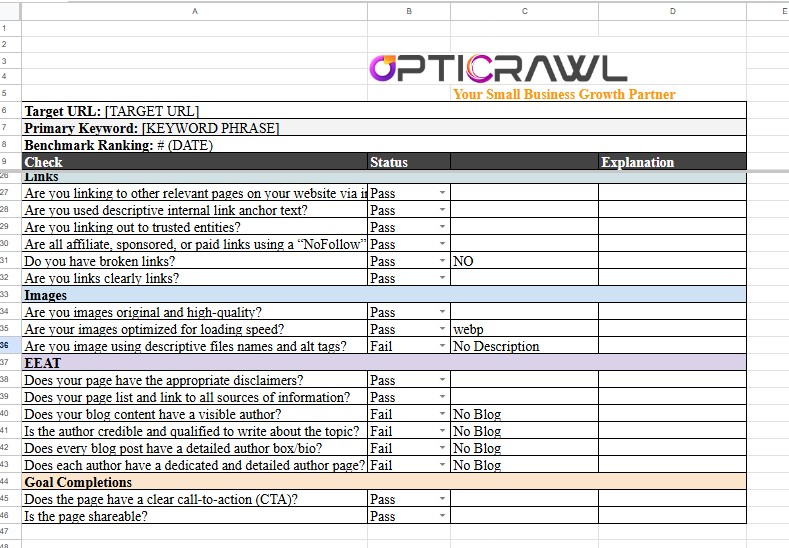
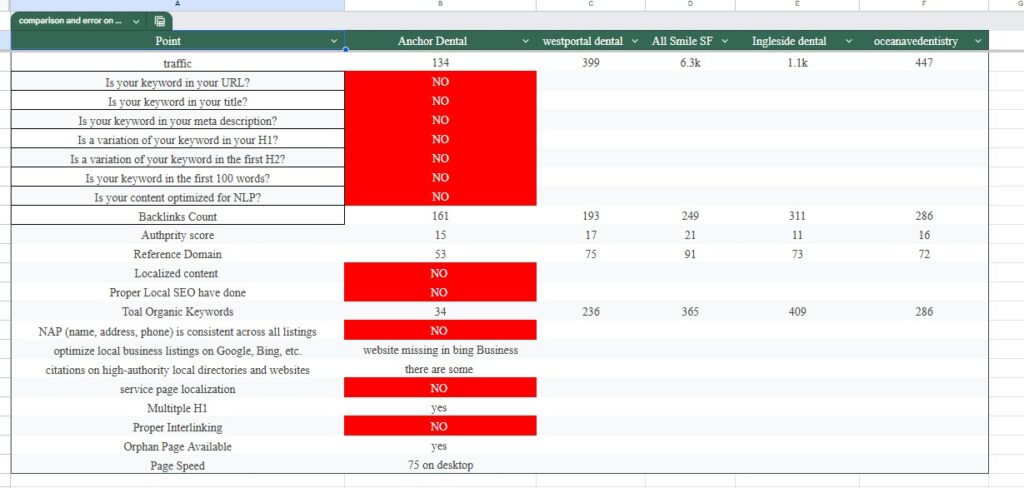
Before launching anything big, you’ve got to size up who you’re up against—and figure out what they’re doing that works (and what they aren’t). This audit focuses on three key questions: Why do others rank higher? What are they doing differently? Where can you win quickly?
Start by auditing the top three local competitors for keywords like “dental implants [city].” Check domain authority and backlinks with tools like Ahrefs or Semrush; count indexed pages and assess content depth around target services; measure review volume plus how recent those reviews are (and if anyone replies); score their Google Business Profile completeness; test page speed alongside Core Web Vitals; verify schema markup presence; then look at service page structure plus word count.
This paints a picture of whether competitors lean more heavily on authority or rich content—or both—and reveals gaps ripe for fast wins.
Next is Content Gap Mapping—compare keyword rankings between your site and theirs. If they rank in top spots for queries where you don’t even show up, that’s an opportunity knocking loudest because no one else is crowding that space yet—you could rank within weeks if done right.
Authority hinges largely on backlinks too—but local ones matter most here: links from community sites like chambers of commerce, local news outlets, dental associations—all carry serious weight locally. Audit competitor backlink profiles carefully for these sources then set about acquiring similar or better links yourself.
Here’s something often overlooked—local sponsorships bring more than goodwill—they regularly earn mentions in trusted .org domains via press coverage tied to schools, sports teams, charity events—you name it. A $2K sponsorship generating three strong backlinks can often outweigh spending $2K purely on content creation when it comes to ranking power.
Review dominance requires attention too: say your top rival has 180 reviews averaging 4.6 stars while you have 40 reviews at 4.8 stars—it’s obvious who has volume advantage despite slightly lower rating quality. Map out how many new reviews you’ll need monthly based on patient volume projections until you’re competitive again—which usually takes six months to a year if done right.
Performance Scenarios
SEO results aren’t just “win” or “lose.” They shift based on market difficulty, existing authority level before starting out, execution speed—and money put behind it all (or not). The numbers below represent modeled outcomes—not guarantees:
Conservative Growth Model assumes some foothold already exists with limited reviews (~20–50) and basic website setup:
– Months 1–3: +5–10 new patients/month → $4K–$8K monthly revenue bump
– Months 4–6: +15–25 patients/month → $12K–$21K revenue impact
– Months 7–12: +30–50 patients/month → $25K–$42K added revenue
Aggressive Growth Model imagines full setup running smoothly in a competitive market with active review collection:
– Months 1–3: +15–25 patients/month → $12K-$21K revenue lift
– Months 4–6: +40–65 patients/month → $34K-$55K impact
– Months 7–12:+75 –120 patients/month → $63K-$102K boost
Multi-location Expansion stacks benefits by compounding domain authority across sites:
– One location averages ~2,500 visits monthly producing ~$85k-$150k
– Three locations jump visits over 6k monthly with production roughly tripling
– Five locations push traffic past 12k visits powering close to half-million dollars in monthly production
Each additional office doesn’t just add traffic—it helps the root domain’s authority grow faster than any single site could alone.
FAQs
What makes dental SEO different from regular SEO?
Dental SEO sits right at crossroads between local search demands plus healthcare rules combined with very focused commercial-intent keywords specific to treatments people seek out online (“root canal cost,” “best Invisalign near me”). Conversion hurdles include showing accepted insurances clearly along with HIPAA-compliant forms—not something typical e-commerce deals with daily! General agencies chase clicks mostly—dental SEO chases real-world appointments instead.
How long till I see results ranking locally?
If you keep Google Business Profiles fully filled out with steady review influxes underway—local pack improvements tend show within two months max usually around weeks four-to-eight organically popping into maps results quicker sometimes sooner actually! Service pages covering competitive treatments may take closer toward half-year mark before hitting high ranks consistently though full system effects combining traffic growth plus conversion improvements typically register measurable revenue lifts somewhere between month four through eight roughly speaking.
What does an effective dental SEO service include?
A winning setup blends Google Business Profile polishing along with treatment-specific landing pages crafted precisely plus citation building rolled into ongoing review request automation paired tightly alongside tech fixes under hood plus steady fresh content streams pumped regularly—not one-and-done projects which dry up fast leaving little residual gain behind at all! Dental SEO isn’t campaign-style anymore but something practices retain continuously because search evolves constantly too…
How do dentists benefit from Local SEO exactly?
It means tuning everything so searches nearby map their way directly toward your practice using tools ranging from GBP tweaks making sure name/address/phone (NAP) data matches everywhere perfectly—including across directories—to managing review cadence ensuring positive flow continues strong while creating localized educational material aimed squarely at nearby audiences needing answers relevant only locally rather than broadly generalized info thrown together haphazardly elsewhere…
What about AEO — Answer Engine Optimization? Why bother?
It boils down to shaping website copy so Google pulls direct answers faster—to snag those featured snippets readers click first—or occupy People Also Ask boxes offering quick guidance when people wonder things about procedures’ pain levels or costs without ever clicking deeper initially—which boosts brand awareness significantly by owning those early question moments even before folks think about booking anywhere else…
And GEO — Generative Engine Optimization — what’s happening there now?
That’s newer territory really—getting ready so AI assistants running searches recommend your practice automatically based on consistent signals scattered online including authoritative content aligned everywhere tied neatly via structured data markup helping bots confirm legitimacy easily… Those ranked highest by AI-driven chat-based systems grab extra visibility lately ahead of traditional web listings which means playing this game well now could mean big advantages tomorrow while others scramble trying to catch up last minute.
Measuring ROI from dental SEO means tracking real conversions—not just raw sessions logged but following leads turning into calls tracked uniquely back to campaigns linking booked appointments through actual shows accounting finally case value per patient summed monthly making true dollar impact visible clearly enough compared against spend revealing how profitable investing here really becomes over time compared especially versus pricey paid ads which burn cash rapidly often providing shorter-term gains only.
In short—you build once carefully configured systems running behind scenes tracking calls properly feeding CRM pipelines growing reviews endlessly boosting ranks across organic maps & content steadily then watch compounding effects take over pushing new seated patients month after month consistently without endlessly pouring money into ads alone… Those nailing this approach win markets not by outspending but by outworking smarter processes every single day.
Internal Linking Suggestions:
Link all “Google Business Profile” mentions straight through dedicated GBP optimization pages;
connect “treatment landing pages” references back to detailed service architecture;
tie “call tracking” mentions into analytics & reporting resources;
and wherever possible answer FAQ questions linking them deeper into specialized content sections available for readers seeking details beyond surface level.
Schema Markup Recommendations Include:
Dentist profile types,
LocalBusiness designation,
FAQPage setups,
Service categories,
MedicalOrganization tags,
plus aggregated Review elements—to help search engines make sense quickly of what’s offered clearly enough.